AI Analyst
Answers you can check, not just a summary.
The AI Analyst runs the statistics on your responses, finds what drives your outcome, splits results by any question and writes recommendations that point to the numbers behind them.
- Key drivers
- Significance tests
- Compare by any question
- Evidence on every finding
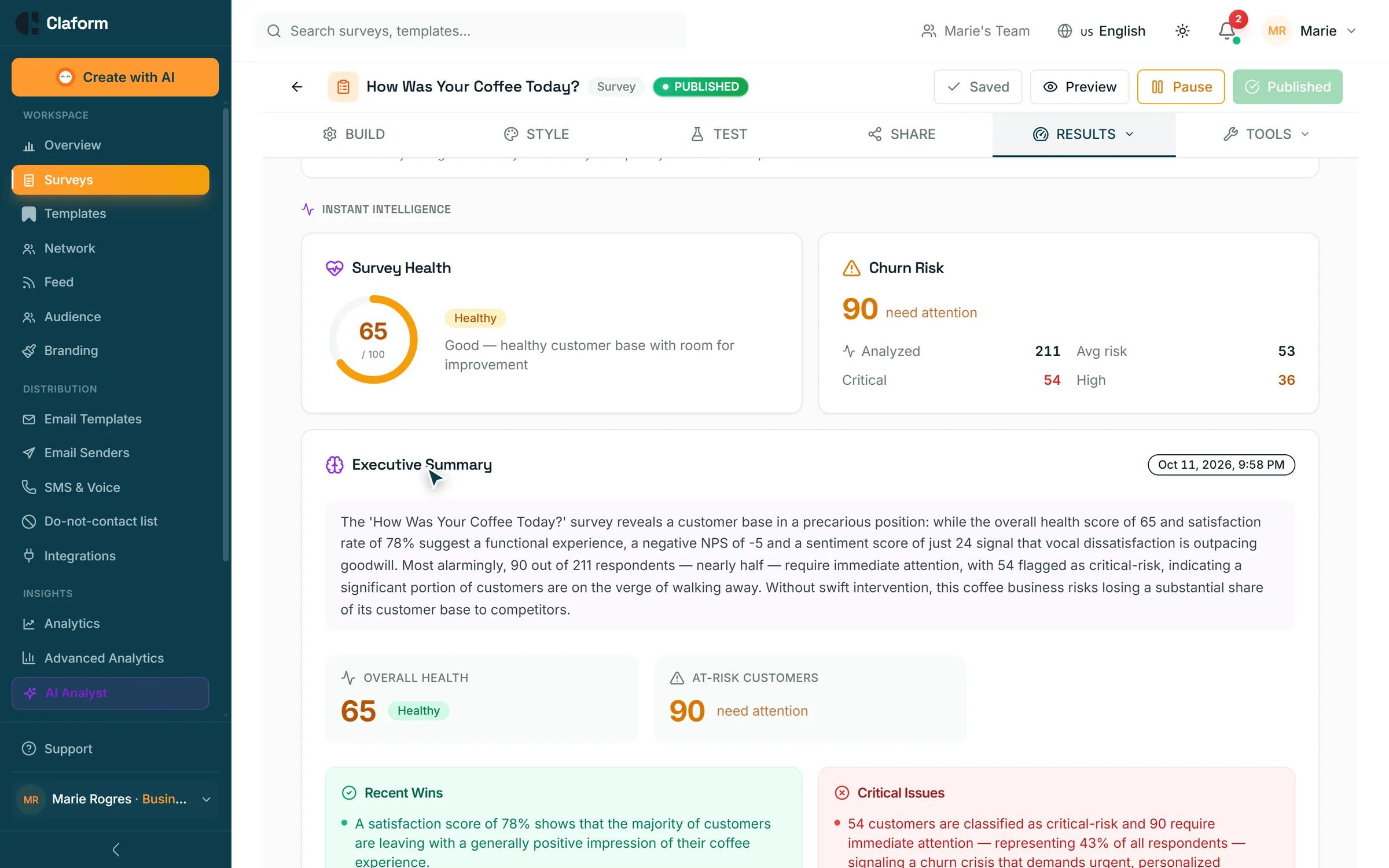
How it works
From the first response to a decision
Quick reads while answers come in, and a deep analysis when you need to decide what to do.
AI summary
A plain-language summary of your results
On the results page, Clue writes a short summary of what respondents said: the headline numbers, the main themes in open answers and what stands out.
- Written from your real responses
- Open-text themes in a few lines
- Uses one AI credit
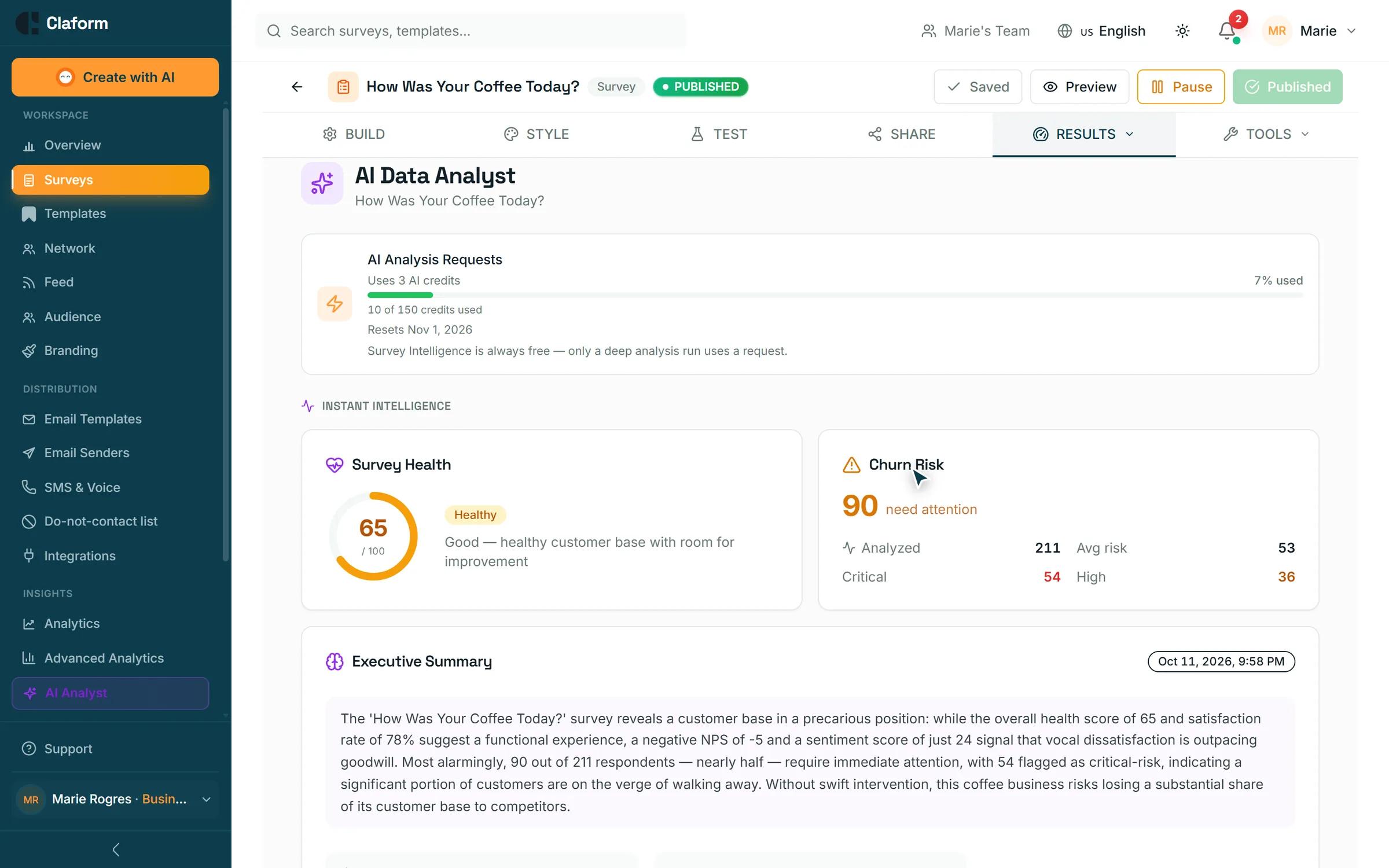
Instant intelligence
Health and churn risk at a glance
Survey intelligence scores the overall health of a survey from satisfaction, loyalty, engagement and sentiment, flags respondents at risk of churning and lists the actions to take first.
- Health score with a short explanation
- At-risk respondents and churn summary
- Re-run it with the latest responses
Deep analysis
A full analysis run, step by step
Pick an outcome and a goal, and the analyst works through descriptive statistics, significance tests, probability estimates, segments and open-text themes, then checks data quality before it writes the report.
- Five specialist steps plus quality checks
- Statistics computed by a stats engine, not guessed
- Written in the language you use Claform in
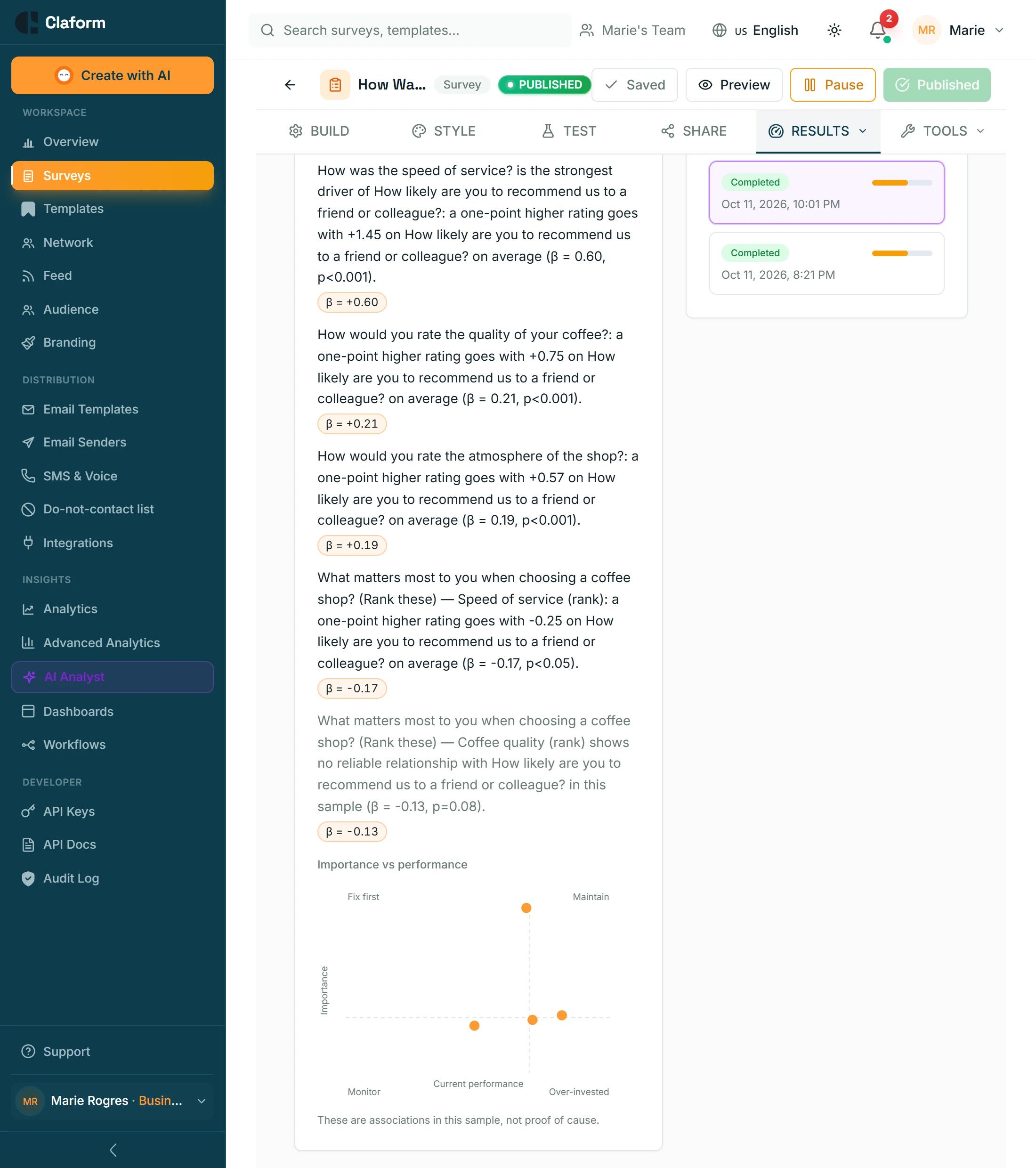
Key drivers and tests
What actually moves your score
Key-driver analysis shows which questions go with a higher or lower outcome and how much of the variation the model explains. Chi-square, t-tests, ANOVA and correlations are corrected for multiple testing.
- Effect sizes and 95% intervals
- Importance versus performance chart
- Associations are labelled as associations, not causes
 Sample data
Compare by
Split every measure by one question
Choose a question, such as location or plan, and every measure in the report is compared across its answers. Small groups are labelled, and groups under ten responses are not shown.
- Averages, NPS and answer shares per group
- The clearest difference called out
- Uses no credits
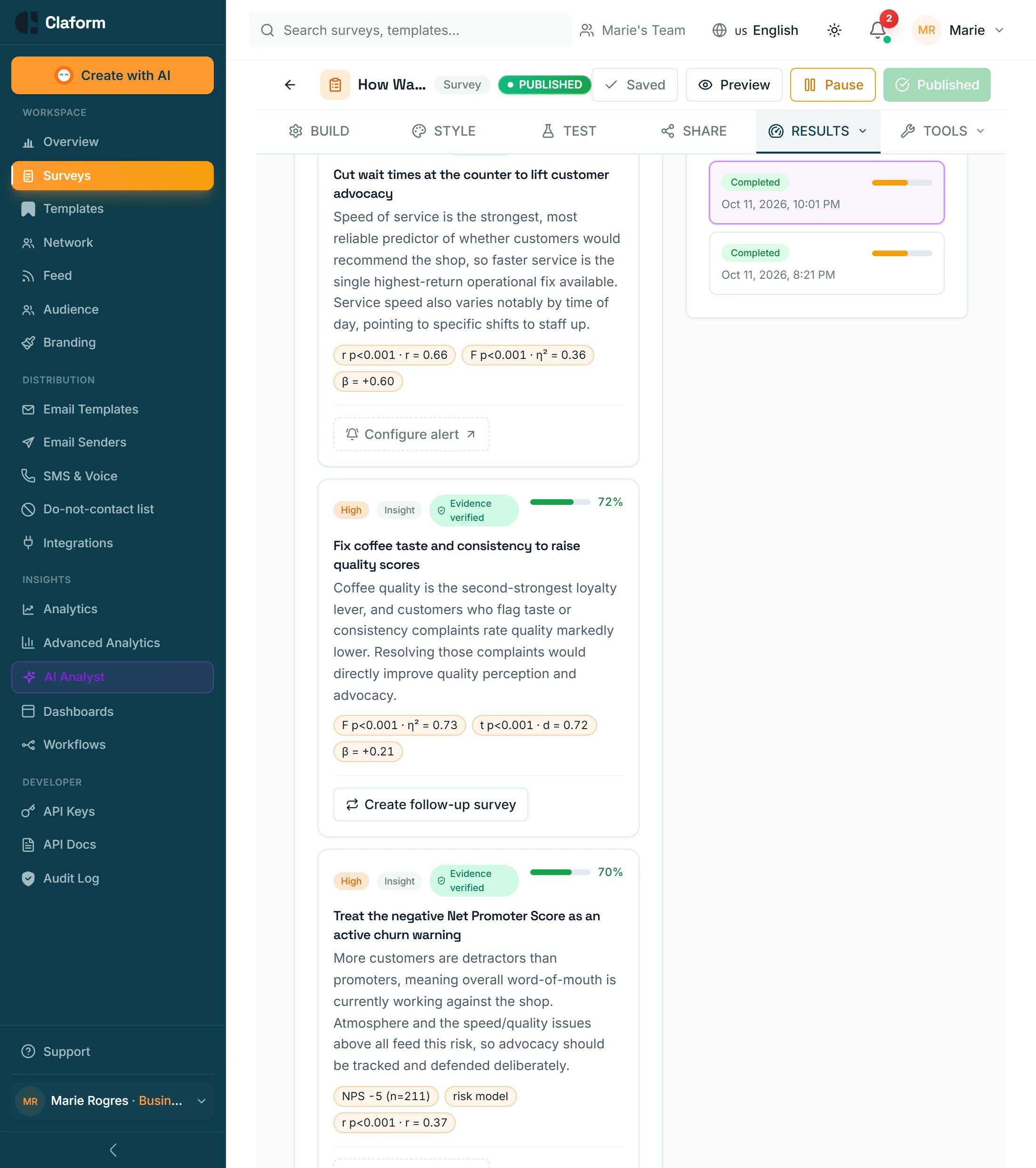
Recommendations
Recommendations that cite their evidence
Each recommendation links to the findings it is based on. Select a citation to see the statistic behind it. A recommendation that cites nothing real is dropped before you see it.
- Evidence chips with test, effect size and sample size
- Priority and timeline for each action
- Unverified items are marked as such
 Sample data
Built for trust
The details that make the report usable
Know how sure the analyst is, run it on a schedule and share the result.
Confidence breakdown
The headline confidence is built from four signals: sample size, how many tests are significant, effect sizes and how many recommendations were verified. Small samples are capped.
Scheduled analyses
Run the analyst daily, weekly or monthly at a time and time zone you choose. If your credits run out, the run is skipped and you are told why.
PDF report
Download the report as a PDF, with your team branding when you have white-label set up.
Shared with your team
Teammates who can open the survey see the same reports, so nobody runs the same analysis twice.
Data-quality caveats
An integrity step flags small samples, unreliable tests and other caveats, so a weak result is never presented as a strong one.
Credits you can predict
A deep analysis run uses 3 AI credits. Comparing by a question is free. If a run fails, its credits are returned.
Every plan includes a monthly allowance of AI credits; the AI Analyst is available on Professional and higher. See pricing for each plan.
The AI Analyst in numbers
- Credits per deep run
- 3Credits per deep runReturned if the run fails
- Credits to compare by
- 0Credits to compare bySplit a finished report by any question
- Confidence signals
- 4Confidence signalsSample, significance, effect size, evidence
- Schedule options
- 3Schedule optionsDaily, weekly or monthly
AI Analyst questions
Does the AI make up the numbers?
No. The statistics are computed by a deterministic stats engine on your responses. The AI writes the narrative and the recommendations, and each recommendation must cite real findings; ones that cite nothing real are removed.
How many responses do I need?
You can run it on any survey with completed responses, but small samples limit what the tests can show. The report flags small samples and caps its confidence when the data is thin.
Which plan includes the AI Analyst?
The AI Analyst is available on Professional and higher. Every plan has a monthly AI credit allowance; a deep analysis run uses 3 credits and comparing by a question uses none.
Can I run it automatically?
Yes. Schedule it daily, weekly or monthly for a survey. Each scheduled run uses 3 credits and is skipped, with a notification, if your credits are used up.
Let the analyst read your results.
Start on the Free plan, then try the AI Analyst on Professional with the trial.