Prerequisites
- A customer group and a touchpoint or relationship you want to measure
The core customer satisfaction question is "How satisfied are you with [product, service or interaction]?" on a 5-point scale from Very dissatisfied to Very satisfied; the CSAT score is the share of respondents who chose the top two points. Around that one question, pick five to nine more from the groups below, matched to the decision you need to make, and add one open-ended "why". The questions here are grouped by goal, each group names the scale to use, and the starter set at the end is ready to send.
Which scale for which group
Use one scale style per group so answers compare cleanly, and label every point.
| Group | Scale | Score to report |
|---|---|---|
| Overall satisfaction | 5-point satisfaction (Very dissatisfied to Very satisfied) | CSAT: share of 4 and 5 |
| Product | 5-point satisfaction or agreement | Top-two-box per attribute |
| Support | 5-point satisfaction, plus 1 to 7 effort for CES | CSAT per ticket; CES average and distribution |
| Onboarding | 5-point ease (Very difficult to Very easy) | Top-two-box, time to first value |
| Pricing and value | 5-point agreement, single choice | Top-two-box, share per option |
| Churn risk | 5-point likelihood, 0 to 10 NPS | Share of Unlikely and Very unlikely; NPS |
| Open-ended | Free text, optional | Themes, quoted alongside the numbers |
The CSAT definition covers the formula; the CSAT calculator does the arithmetic from your counts.
Overall satisfaction (6 questions)
Scale: Very dissatisfied, Dissatisfied, Neither satisfied nor dissatisfied, Satisfied, Very satisfied.
- How satisfied are you with [Company] overall?
- How satisfied are you with your most recent experience with us?
- How well does [product] meet your needs? (Not at all well to Extremely well)
- Compared with your expectations when you signed up, [product] is: Much worse, Worse, About the same, Better, Much better
- How satisfied are you with the quality of [product or service]?
- Thinking about the last three months, has your satisfaction with [Company] gone up, stayed the same or gone down?
Question 1 is the CSAT question for a relationship survey. Question 2 is the one to use after a purchase, delivery or appointment, where the memory is specific.
Product (7 questions)
Scale: 5-point satisfaction for ratings, 5-point agreement (Strongly disagree to Strongly agree) for statements.
- How satisfied are you with the reliability of [product]?
- How satisfied are you with how easy [product] is to use?
- How satisfied are you with the features available to you?
- "[Product] helps me get [job] done faster." (agreement)
- "I can find what I need in [product] without help." (agreement)
- Which of the following features do you use at least weekly? (multiple choice, list your top 8 features)
- If you could change one thing about [product], what would it be? (open text)
Ask attribute ratings (7 to 9) only for attributes you can act on. A matrix of three to five rows with the same satisfaction scale keeps this group short.
Support and service (7 questions)
Scale: 5-point satisfaction, except question 17, which uses the Customer Effort Score scale.
- How satisfied are you with the support you received on [ticket or date]?
- How satisfied are you with how quickly we responded?
- How satisfied are you with the knowledge of the person who helped you?
- How much effort did you have to put in to get your issue resolved? (1 Very low effort to 7 Very high effort)
- Was your issue resolved? Yes, completely; Partly; No
- How many times did you have to contact us about this issue? Once; Twice; Three or more times
- How satisfied are you with the help documentation and self-service options?
Send this group within 24 hours of the ticket closing. For the effort question and how to read it, see the Customer Effort Score guide.
Onboarding and first use (6 questions)
Scale: Very difficult, Difficult, Neither, Easy, Very easy.
- How easy was it to get started with [product]?
- How easy was it to set up [first key task, e.g. your first project]?
- How long did it take to get your first [result] from [product]? Less than a day; 1 to 3 days; 4 to 7 days; More than a week; I have not yet
- Which onboarding resources did you use? Welcome emails; Documentation; Video tutorials; A call with our team; None (multiple choice)
- How useful were the onboarding resources you used? (Not at all useful to Extremely useful)
- Was anything unclear or missing during your first week? (open text)
Send between day 7 and day 14 after sign-up, when the experience is still fresh and the respondent has had time to form a view.
Pricing and value (5 questions)
Scale: 5-point agreement unless noted.
- "[Product] is worth what I pay for it." (agreement)
- How would you describe the price of [product]? Much too low; Somewhat low; About right; Somewhat high; Much too high
- "The pricing is easy to understand." (agreement)
- Which plan features matter most to the price you are willing to pay? (ranking, 4 to 6 items)
- How satisfied are you with the billing and payment process?
Pricing questions produce honest answers when they sit near the end of the survey and after the product questions, so respondents have already thought about what they get.
Churn risk and loyalty (6 questions)
Scale: 5-point likelihood (Very unlikely to Very likely) unless noted.
- How likely are you to renew [or: keep using] [product] next year?
- How likely are you to recommend [Company] to a friend or colleague? (0 Not at all likely to 10 Extremely likely)
- Have you considered switching to another provider in the last six months? Yes, actively; Yes, briefly; No
- Which of the following would make you more likely to stay? (multiple choice: lower price, specific feature, better support, faster product, other)
- How likely are you to buy from [Company] again?
- "I would be disappointed if I could no longer use [product]." (agreement)
Question 33 is the standard NPS question. Report it as NPS and keep the 0 to 10 scale exactly; do not mix it with the 5-point items.
Open-ended questions (8 questions)
Make these optional and show one or two per survey, usually right after the rating they explain.
- What is the main reason for your score?
- What do you like most about [product]?
- What is the one thing we could do to improve your experience?
- What almost stopped you from buying or signing up?
- Which other products did you consider, and why did you choose us?
- Is there anything you expected [product] to do that it does not?
- Describe a recent moment when [product] made your work easier or harder.
- Anything else you would like us to know?
Skip logic makes these sharper: show "What went wrong?" to people who rated 1 or 2, and "What worked well?" to people who rated 4 or 5.
A 10-question starter survey
Use this for a quarterly relationship survey. About 3 minutes.
| # | Question | Type |
|---|---|---|
| 1 | How satisfied are you with [Company] overall? | 5-point satisfaction |
| 2 | What is the main reason for your score? | Open text, optional |
| 3 | How satisfied are you with the reliability of [product]? | 5-point satisfaction |
| 4 | How satisfied are you with how easy [product] is to use? | 5-point satisfaction |
| 5 | How satisfied are you with the support you have received? | 5-point satisfaction, Not applicable option |
| 6 | "[Product] is worth what I pay for it." | 5-point agreement |
| 7 | How likely are you to recommend [Company] to a friend or colleague? | 0 to 10 |
| 8 | How likely are you to renew next year? | 5-point likelihood |
| 9 | What is the one thing we could do to improve your experience? | Open text, optional |
| 10 | Which best describes your role? | Single choice, 4 to 6 options |
Report questions 1, 3, 4 and 5 as CSAT (top-two-box share), question 7 as NPS, question 8 as the share of Unlikely and Very unlikely, and break each by question 10.
Calculating the CSAT score
CSAT = (number of Satisfied + Very satisfied responses) / (total responses to the question) × 100.
Example: 140 Very satisfied, 210 Satisfied, 90 Neither, 40 Dissatisfied, 20 Very dissatisfied, 500 total. CSAT = (140 + 210) / 500 × 100 = 70 percent. Report the distribution with it: 70 percent satisfied, 18 percent neutral, 12 percent dissatisfied. Exclude Not applicable from the denominator.
Common mistakes
- Asking about overall satisfaction after ten detail questions. Put it first so earlier answers do not shape it.
- Mixing scale lengths (a 1 to 10 satisfaction next to a 5-point one). Keep 0 to 10 for NPS only.
- Reporting CSAT as an average (3.8 out of 5). Report the top-two-box share and the distribution.
- Required open-text questions. Make them optional.
- Attributes you cannot change. Rate only what a team owns.
- Surveying the same customer every week. Once per quarter for relationship surveys; per event for transactional ones, with a cap.
- No Not applicable option on the support question for customers who never contacted support.
Doing this in Claform
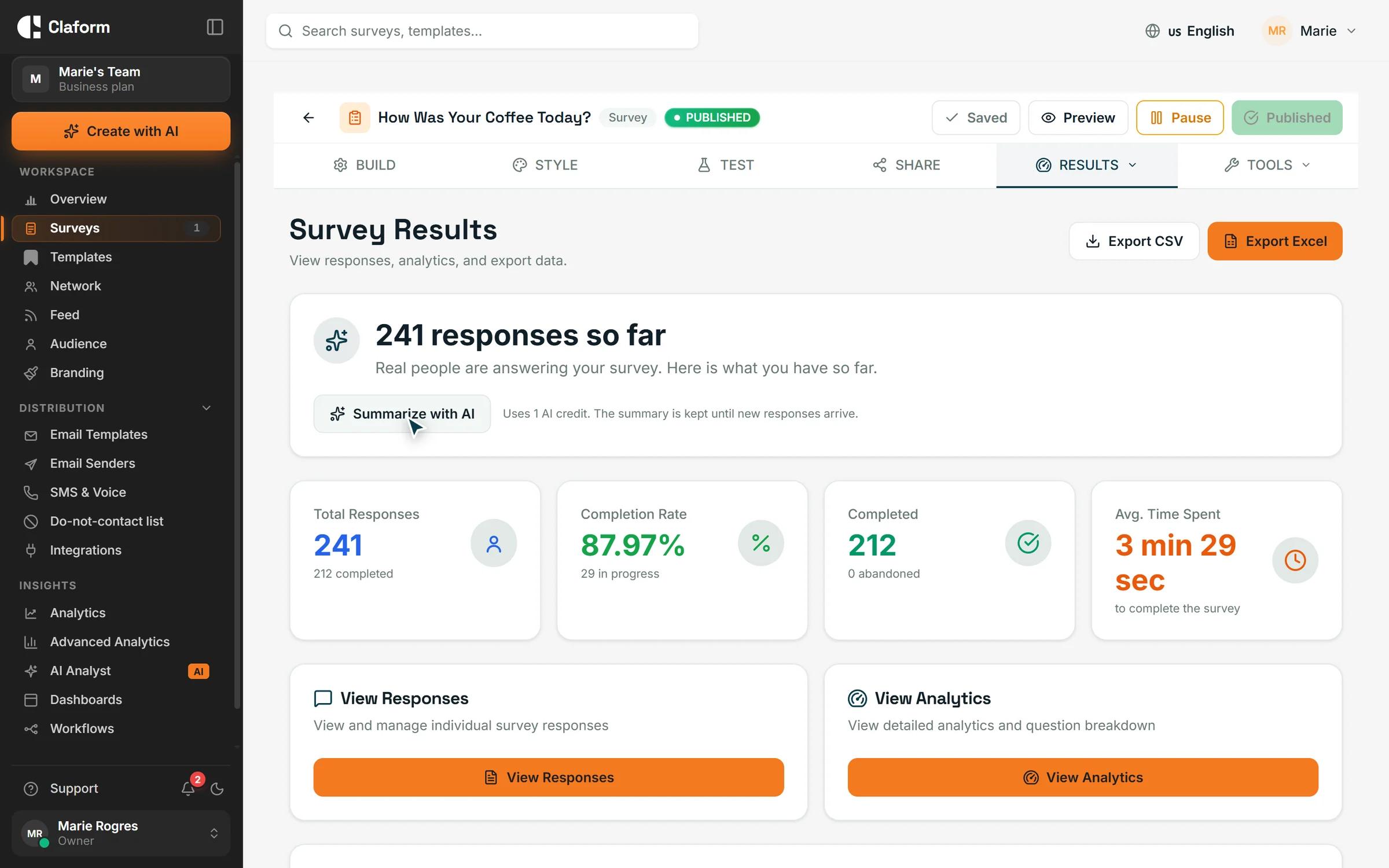
The CSAT survey template contains the starter set above and can be edited in the builder; the rating, opinion scale, matrix and NPS question types give you every scale in this guide with labels on each point. Set skip logic on the satisfaction question so the right open-ended follow-up appears, then send by email after a purchase or ticket, or on a schedule for the quarterly survey, with one reminder. The results view shows each question as a distribution, and compare-by breaks CSAT down by the role, plan or segment question. The customer feedback use case shows how the survey fits a feedback loop.
Frequently asked questions
What is the best customer satisfaction question?
"How satisfied are you with [specific product, service or interaction]?" on a 5-point scale from Very dissatisfied to Very satisfied. Name the thing you are asking about, place the question first, and follow it with an optional "What is the main reason for your score?"
How many questions should a customer satisfaction survey have?
Five to ten for a relationship survey, one to three for a transactional survey sent after a purchase or support ticket. Each question should map to something a team can change; cut anything that does not.
What is a good CSAT score?
It depends on the industry and the touchpoint, so compare against your own previous results first. Support interactions usually score higher than overall product satisfaction because the question is about a specific, recent event. Track the trend and the share of dissatisfied customers rather than chasing one number.
Should I use a 5-point or a 10-point scale for CSAT?
Use 5 points with every point labeled. It reads well on a phone and the top-two-box score is easy to explain. Keep 0 to 10 for the NPS question only, so the two metrics are not confused in the report.
How often should I send a customer satisfaction survey?
Transactional surveys go out within a day of the event (purchase, delivery, ticket), with a cap so no customer is asked more than once a month. Relationship surveys go out once a quarter or twice a year to the whole base.

Programs and playbooks