Prerequisites
- A survey that is written and ready to send
A good survey introduction says five things in under 80 words: why you are asking, how long it will take, whether answers are anonymous or confidential, how the data will be used, and whom to contact with questions. Write it in plain second person, put the time estimate in the first two sentences, and make every promise one you can keep. The ten examples below are complete and ready to copy; change the bracketed parts.
This page covers the rules, the examples by situation, and the differences between the invitation (email or message) and the welcome screen (the first page of the survey).
The five things every survey introduction must say
| Element | Why it matters | Example phrasing |
|---|---|---|
| Purpose | People answer when they know what the answers are for | "We are deciding how to shorten the sign-up process." |
| Time | Sets expectations; an honest number raises completion | "This takes about 3 minutes (8 questions)." |
| Anonymity or confidentiality | Decides how candid people are; must be true | "Responses are anonymous; we do not record your name or email." |
| Use of data | Builds trust and sets up the follow-up | "Results are reported in aggregate to the product team." |
| Contact | Shows a person stands behind the survey | "Questions? Reply to this email or write to [email protected]." |
Two words get mixed up. Anonymous means you cannot link an answer to a person, even if you wanted to. Confidential means you could, but you limit who sees it and how it is reported. Promise the one you can deliver. If the survey link is personalized so you can send reminders, the survey is confidential, not anonymous.
Rules for the wording
- Lead with purpose or time, not with "We value your feedback."
- Give a real time estimate. Test it with a colleague and round up.
- Say what happens with the results, in one sentence, in the future tense.
- Keep it under 80 words on the welcome screen and under 120 in an email.
- Use the respondent's language, not yours: "your last order", not "your recent transaction".
- Put the deadline in the invitation, not the welcome screen.
- Sign with a name and a role for employee and research surveys; a team name is fine for customers.
10 survey introduction examples
1. Customer satisfaction after a purchase
Thanks for your order from [Company]. We would like to know how it went so we can fix what did not work. This survey takes about 2 minutes (6 questions). Your answers are confidential and reported in aggregate to our fulfillment team. If something needs fixing right now, reply to this email and we will sort it out.
2. Customer relationship survey (annual or quarterly)
Once a year we ask our customers how we are doing and what to change. Your answers shape next year's priorities, and we publish what we decided in [month]. The survey takes about 5 minutes. Responses are confidential; we report them by customer segment, never by name. Questions? Write to [name] at [email].
3. Employee engagement survey
This is our [quarterly] engagement survey. It takes about 7 minutes and asks about your work, your team, your manager and the company. Responses are anonymous: the survey is run by [vendor or HR team], no individual answer is shown to anyone, and results are reported only for groups of five or more. Leadership will share the results and the actions by [date]. Thank you for being direct.
Say who runs the survey and the minimum group size. Employees do not believe "anonymous" without that detail.
4. Event feedback
Thank you for attending [Event]. Tell us what worked and what to change for next time. This takes about 3 minutes. Your answers are anonymous and go to the organizing team. If you would like to be contacted about next year's program, there is an optional field at the end.
5. Academic or market research study
You are invited to take part in a study on [topic], run by [institution or team]. Participation is voluntary, takes about 12 minutes, and you may stop at any time. Your answers are anonymous and will be used only for [purpose, e.g. aggregated statistical analysis]. This study was reviewed by [ethics board, if applicable]. For questions about the study, contact [name] at [email].
Research intros are longer because consent needs to be informed. Keep the extra length in the consent lines, not in the description of the topic.
6. Patient or healthcare experience survey
We would like to hear about your recent visit to [Clinic] on [date]. The survey takes about 4 minutes. Your answers are confidential, are not added to your medical record, and do not affect your care. We use them to improve the experience for all patients. If you have a concern about your care, please call [number] rather than using this survey.
7. Anonymous survey on a sensitive topic
This survey asks about [topic, e.g. workplace conduct]. It is fully anonymous: we do not collect names, email addresses, IP addresses or device information, and the link is the same for everyone. It takes about 5 minutes. Results will be shared with [who] as counts and percentages only. If you want to report something that needs action, use [channel] instead, because we cannot follow up on anonymous answers.
The last sentence matters. Anonymous surveys cannot respond to an individual, and people need to know where to go if they need a response.
8. Survey with an incentive
Help us decide what to build next and enter a drawing for one of five [$50] gift cards. The survey takes about 6 minutes. Your answers are confidential and reported in aggregate. To enter the drawing, leave an email address on the last page; it is stored separately from your answers and used only to contact winners by [date]. Full rules: [link].
Separate the entry from the answers in the wording and in practice. Say how winners are picked and when.
9. Long survey (15 minutes or more)
This survey takes about 15 minutes. We know that is a lot, and we have cut it as far as we can. It covers [three areas], and your progress is saved so you can return to the link later. Answers are confidential and reported by group. The results will set [what decision], and we will share them with you by [date]. Thank you for the time.
Be honest about the length. People abandon a "5-minute survey" at minute eight far more often than they abandon a "15-minute survey" at minute eight.
10. Website or in-app feedback (short intercept)
Got 30 seconds? Two quick questions about this page. Anonymous, no sign-up.
Intercepts need the shortest possible introduction. Time, anonymity, done.
Invitation versus welcome screen
The invitation (an email, an SMS or a message) and the welcome screen (the first page of the survey) do different jobs, and the text should not be identical.
| Invitation | Welcome screen | |
|---|---|---|
| Job | Get the click | Get the first answer |
| Length | 60 to 120 words | 30 to 80 words |
| Must include | Purpose, time, deadline, link, sender | Purpose, time, anonymity, contact |
| Can skip | Detailed anonymity wording (link to it) | Deadline, greeting, signature |
| Tone | Personal, from a named sender | Direct, second person |
Many teams put the full introduction in the invitation and a one-line reminder on the welcome screen: "About 3 minutes, anonymous. Thanks for helping." That works when most respondents arrive from the invitation. If the survey is also shared by QR code or open link, the welcome screen has to stand alone. Invitation subject lines and body copy are covered in survey email invitations.
Common mistakes
- "We value your feedback" as the first sentence. Replace it with the purpose.
- A time estimate nobody tested. Time it on a phone and round up.
- Promising anonymity while using personalized links or collecting email for an incentive. Say "confidential" instead, or separate the collection.
- Explaining the company's history or mission in the intro. Nobody reads it.
- No mention of what happens next. Add one sentence about when results or actions will be shared.
- Different promises in the email and on the welcome screen. Reuse the same anonymity sentence in both.
- A deadline in the welcome screen that has passed when someone opens the QR code a month later.
Doing this in Claform
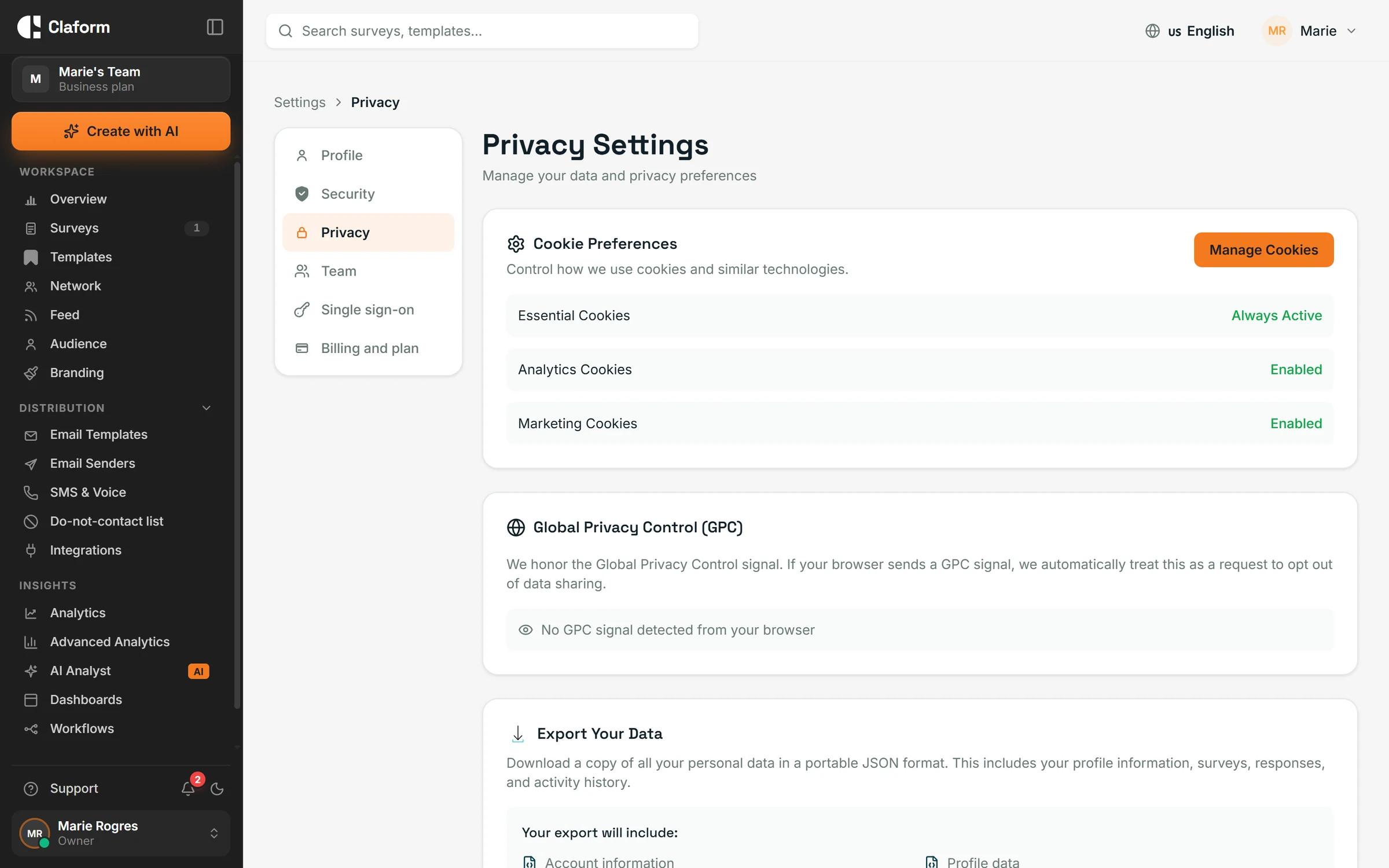
In the survey builder, the introduction goes in a heading and text block at the top of the survey, so you can paste any example above and preview it on a phone. The anonymity line should match the survey's privacy settings: the anonymous responses setting stops the survey from storing IP address, device details and location with each answer, and if you keep personalized links for a confidential survey, reminders to non-responders still work. Invitations by email, SMS and WhatsApp have their own message text, separate from the introduction inside the survey, and you can schedule the send and the reminders from the same screen. See survey email invitations for the invitation side and the survey builder for the welcome page.
Frequently asked questions
How do you start a survey introduction?
With the purpose or the time, in one sentence: "We are deciding how to shorten sign-up; this survey takes 3 minutes." Skip greetings and thanks at the top; put thanks at the end. Respondents decide whether to continue within the first two sentences.
How long should a survey introduction be?
Under 80 words on the welcome screen and under 120 in an email invitation. Research studies that need informed consent run longer, but keep the extra length in the consent lines, not in the description of the topic.
Should a survey introduction say the survey is anonymous?
Only if it is. Anonymous means no name, email, IP address or personalized link can connect an answer to a person. If you send personalized links for reminders or collect an email for a prize, say "confidential" and explain who sees the data.
What is the difference between a survey invitation and a survey introduction?
The invitation is the email or message that gets the click; it carries the deadline and a sender. The introduction is the welcome screen inside the survey; it carries purpose, time, anonymity and contact, and has to stand alone for people who arrive by link or QR code.

Product usage, templates and distribution